
Why Your Kitchen Faucet Drips
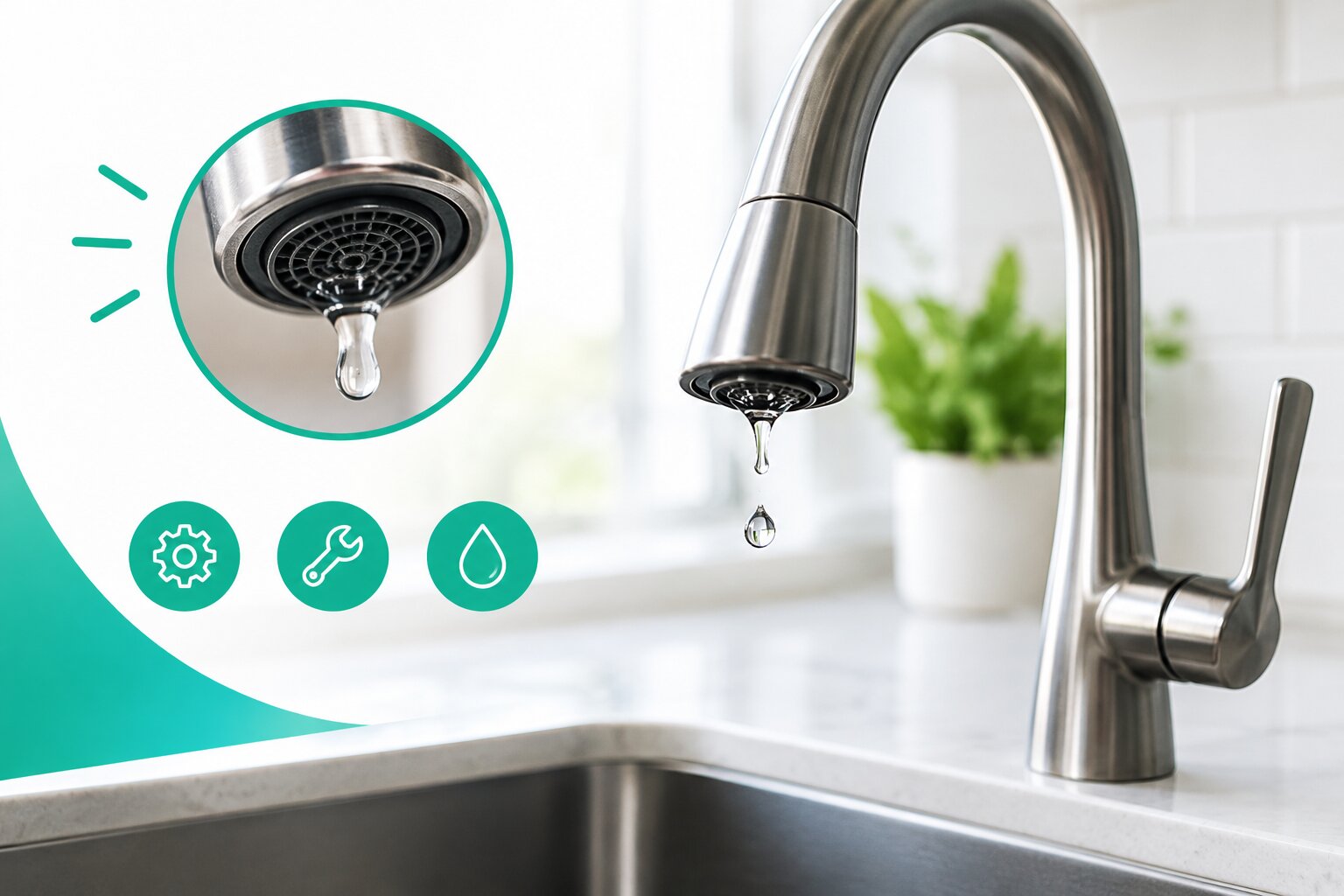
You’ve been hearing that annoying drip, drip, drip from your kitchen faucet, but you can’t seem to figure out what is causing it. After making sure each of the handles on your faucet is turned securely to the “off” position, it’s time to start thinking about what could be causing your kitchen faucet leak.
What Causes a Kitchen Faucet to Drip?
A dripping kitchen faucet can develop for several reasons, and the location of the leak often provides useful clues. Identifying the underlying cause is important because tightening a handle or cleaning the faucet may not resolve a problem involving worn internal components.
1. Turn Off the Water Supply
Before inspecting or repairing a faucet, shut off the hot and cold water supply valves beneath the sink, if accessible. Turn the faucet on to release remaining water pressure and confirm that the water supply has stopped.
Place a towel or small container beneath the work area to catch residual water. If the shutoff valves are stuck, corroded, or leaking, do not force them. Contact a plumber for assistance.
2. Inspect the Faucet Handle and Connections
Look for visible damage, loose components, or signs of corrosion. If the handle is loose, consult the manufacturer’s instructions to determine whether it can be tightened safely.
Avoid overtightening screws or fittings. A loose handle may not be the actual source of the drip, and excessive force can damage the faucet.
3. Clean the Aerator if Necessary
The aerator is the small attachment at the end of many faucet spouts. It helps regulate water flow and can collect mineral deposits over time.
If water flow has become uneven or restricted, removing and cleaning the aerator according to the manufacturer’s instructions may help. Use a suitable cleaning method for the faucet’s finish and materials.
Keep in mind that a clogged aerator does not usually explain a continuous leak from a closed faucet. If dripping persists after cleaning, the internal valve or seals may need attention.
4. Check Whether Internal Parts Need Replacement
A worn washer, damaged O-ring, or faulty cartridge may need to be replaced to restore a proper seal. The repair procedure varies depending on whether the faucet uses a compression valve, cartridge, ceramic disc, or another mechanism. Always use parts that are compatible with the specific faucet model. Incorrect components or improper installation can cause additional leaks.
If the faucet requires extensive disassembly or you are unsure how to proceed, professional service can help prevent damage and ensure the repair is completed correctly.
5. Test the Faucet After the Repair
Once any permitted repair is complete, restore the water supply gradually and check the faucet’s operation. Look for leaks around the handle, spout, base, and accessible supply connections.
Operate both hot and cold water controls, where applicable, and inspect the area beneath the sink for moisture. If the faucet continues to drip or a new leak appears, turn off the water supply if safe and arrange a professional inspection.
When Should You Call a Professional Plumber?
Although some faucet problems are relatively simple, not every leak is suitable for a DIY repair. A professional plumber can identify the underlying cause and help prevent recurring issues.
Consider contacting a plumber if:
- The faucet keeps dripping: The leak continues even after basic checks or a previous repair.
- Water leaks beneath the sink: Moisture around supply connections or inside the cabinet may indicate a more serious plumbing issue.
- The faucet is heavily corroded: Damaged components can make repairs difficult or unreliable.
- The handle is stuck or difficult to operate: The internal mechanism may be damaged or affected by mineral deposits.
- You cannot identify the source: Water may be escaping from the faucet body, supply line, or another nearby plumbing component.
- Several fixtures show signs of trouble: Multiple leaks or unusual water flow may indicate a broader plumbing concern.
Getting the problem assessed early can help prevent unnecessary water waste and reduce the risk of damage to surrounding cabinets and fixtures.

Should You Repair or Replace a Dripping Kitchen Faucet?
Repairing a faucet is often a sensible option when the problem is limited to a replaceable component, such as a cartridge, washer, or seal. If the fixture is relatively new and otherwise in good condition, a targeted repair may restore its performance without requiring a complete replacement.
Replacement may be worth considering when the faucet has extensive corrosion, a cracked body, repeated leaks, or multiple worn components. It may also be appropriate when compatible replacement parts are difficult to obtain.
Consider the faucet’s age, condition, repair cost, and availability of replacement parts before making a decision. A qualified plumber can evaluate the fixture and explain whether repair or replacement is the more practical long-term choice.
If you think your kitchen faucet is leaking because of one of the reasons described above, be sure to get in touch with CW Service Pros. Once the job is done, you will rest easy knowing your faucet will be working smoothly for a long time to come.
FAQs
Why does my kitchen faucet drip only when I use hot water?
A kitchen faucet that drips only when hot water is running may have a worn cartridge, damaged seal, or loose internal component. Heat-related expansion can sometimes make an existing defect more noticeable. A plumber can inspect the faucet to identify the source and determine whether a replacement part is needed.
Can a dripping kitchen faucet increase my water bill?
Yes. Even a slow, continuous drip can waste water over time, potentially increasing your water bill. The amount depends on the drip rate and how long the leak continues. Fixing the problem promptly helps conserve water and prevents the leak from becoming a more significant plumbing issue.
Why does my kitchen faucet drip from the handle instead of the spout?
Water leaking around the handle may indicate a worn O-ring, damaged cartridge, deteriorated seal, or loose connection. This differs from a spout drip, which often points to a problem with the internal valve or sealing components. Identifying where the water appears can help narrow down the cause.
Should I replace my kitchen faucet if it keeps dripping?
Not necessarily. Replacing a worn washer, O-ring, or cartridge may resolve the problem if the faucet is otherwise in good condition. However, replacement may be more practical if the fixture is heavily corroded, damaged, outdated, or repeatedly develops leaks. A professional assessment can help you choose the appropriate solution.
Can hard water cause a kitchen faucet to leak?
Hard water contains minerals such as calcium and magnesium that can accumulate inside faucet components. Over time, mineral deposits may interfere with proper operation and contribute to wear around seals and valves. Cleaning removable components may help, but damaged internal parts might require replacement.
When should I call a plumber for a dripping kitchen faucet?
Contact a plumber if the drip continues after basic checks, the handle becomes difficult to operate, water leaks around the faucet base, or you notice moisture inside the cabinet beneath the sink. Persistent leaks may indicate damaged components or a connection problem that requires professional attention.