Do Radiant Barriers Work in North Texas?

Reviewed by: CW Service Pros
Last updated: September 15
Radiant barriers do work in North Texas by reflecting up to 95 percent of radiant heat away from the attic space, reducing cooling loads during extreme summer heat. However, they do not replace conventional attic insulation and perform best as a supplement to proper R-value insulation and air sealing.
If your attic temperatures soar above 130 degrees and your air conditioner runs non-stop despite having adequate insulation, your home is suffering from intense radiant heat transfer. Installing or repairing a radiant barrier requires working safely near roof decking and electrical lines, making it a job for trained technicians. CW Service Pros can inspect your attic to determine if a radiant barrier will effectively lower your cooling demand.
How Does a Radiant Barrier Work in an Attic?
A radiant barrier works by reducing radiant heat transfer from the underside of a hot roof deck into the attic space. Unlike standard insulation, which slows conductive heat flow through solid materials, a radiant barrier consists of a highly reflective material—usually aluminum foil—applied to a substrate like kraft paper, plastic film, or oriented strand board.
The U.S. Department of Energy explains that radiant barriers reflect radiant heat rather than absorbing and re-radiating it into the home. When solar energy strikes a roof deck, the material heats up and radiates that energy downward across the open attic air space toward the insulation floor. A properly installed radiant barrier reflects that radiant heat back toward the roof, keeping attic temperatures significantly lower during hot summer months.
According to research from the Oak Ridge National Laboratory, radiant barriers are particularly effective in hot, sunny climates where cooling loads dominate annual energy consumption. However, they only address radiant heat gain and do not prevent heat from conducting through the attic floor once thermal energy accumulates in the space.
Is a Radiant Barrier Better Than Attic Insulation?
A radiant barrier is not better than attic insulation because they perform entirely different thermodynamic functions in your building envelope. Insulation resists conductive heat transfer, whereas a radiant barrier reflects radiant energy before it can heat attic surfaces.
The U.S. Department of Energy notes that radiant barriers do not carry a meaningful R-value and should never be used as a replacement for standard thermal insulation.
Here is how radiant barriers compare to conventional attic insulation:
| Feature | Radiant Barrier | Conventional Attic Insulation |
| Primary Mechanism | Reflects radiant solar energy | Slows conductive heat transfer |
| Performance Metric | Emissivity and reflectivity | R-value (thermal resistance) |
| Primary Benefit | Lowers attic air temperatures | Blocks heat transfer into living areas |
| Installation Location | Underside of roof rafters or deck | Flat on the attic floor |
To achieve maximum energy efficiency, your attic requires sufficient R-value insulation on the attic floor first. A radiant barrier serves as an effective secondary layer to keep the overall attic envelope cooler, reducing duct heat gain and easing the burden on your HVAC unit.
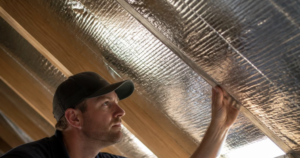
A technician inspecting a foil-faced radiant barrier attached to roof trusses next to an open air gap.
How Is a Radiant Barrier Properly Installed?
A radiant barrier is properly installed by attaching reflective foil to the underside of roof rafters or utilizing foil-faced roof sheathing with the reflective side facing down into an open air gap.
The U.S. Department of Energy emphasizes that a radiant barrier requires an adjacent air space facing the reflective surface to work effectively. If dust settles directly on the reflective face or if the foil is sandwiched flat between two solid materials without an air gap, it loses its ability to reflect radiant heat.
Proper installation also requires leaving adequate ventilation clearance. Technicians must avoid blocking soffit vents or ridge vents during installation to preserve proper attic airflow and prevent moisture accumulation.
Does Dust Affect Radiant Barrier Performance?
Dust accumulation significantly reduces radiant barrier performance when foil is installed horizontally over the attic floor insulation. Over time, airborne particles settle onto the top reflective surface, increasing its emissivity and drastically lowering its ability to reflect heat.
The U.S. Department of Energy recommends installing radiant barriers vertically or draped under roof rafters rather than flat on the attic floor to minimize dust accumulation.
When draped along the rafters with the shiny side facing down into the attic cavity, dust cannot collect on the reflective surface, ensuring long-term thermal effectiveness without maintenance.
Is a Radiant Barrier Worth It for North Texas Homes?
A radiant barrier is particularly effective in North Texas because Denton County and surrounding areas fall into IECC climate zone 3A, a warm-humid climate where cooling dominates energy usage for most of the year. During Texas summers, roof deck temperatures frequently exceed 150 degrees, radiating extreme thermal energy into the attic cavity and warming HVAC ductwork.
ENERGY STAR recommends maintaining an attic insulation level of R-38 to R-49 in climate zone 3A, but adding a radiant barrier helps block solar heat before it reaches that thermal insulation layer.
Consider booking a professional attic assessment if you notice any of the following conditions in your home:
-
Attic temperatures remain well above 120 degrees late into the summer evening.
-
Your HVAC ductwork is located in an unconditioned attic space.
-
Your upper-story ceilings feel hot to the touch during peak daylight hours.
-
Your cooling system runs constantly while struggling to maintain setpoint temperatures.
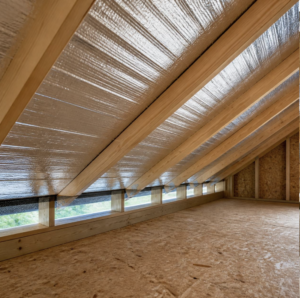
An interior view under attic rafters showing shiny radiant barrier foil neatly draped along the roof deck with visible ventilation clearance.
Frequently Asked Questions About Attic Radiant Barriers
Does a radiant barrier replace attic insulation?
No, a radiant barrier cannot replace traditional attic insulation. The U.S. Department of Energy states that radiant barriers lack a meaningful R-value and only reflect radiant heat, while thermal insulation is required to slow conductive heat movement through the ceiling plane.
Will a radiant barrier damage my roof shingles?
No, a properly installed radiant barrier will not damage your asphalt roof shingles. The Florida Solar Energy Center found that radiant barriers increase shingle temperatures by only 2 to 5 degrees, which stays well within manufacturer operating tolerances for roofing materials.
Can I add a radiant barrier’s effect to my insulation R-value?
No, you cannot add a radiant barrier to an R-value calculation. The U.S. Department of Energy notes that radiant barriers do not possess thermal resistance R-values; they reduce radiant heat gain across open air spaces rather than resisting conduction through materials.
Do radiant barriers block cell phone or Wi-Fi signals?
No, interior attic radiant barriers do not noticeably affect Wi-Fi or cellular reception inside living spaces. Because the foil material is mounted high under the roof deck, household radio signals from lower floors easily pass through interior walls and windows without interference.
Protect Your Home from Texas Heat Today
Optimizing your attic envelope requires the right combination of air sealing, proper R-value insulation, and radiant barriers. Let the licensed technicians at CW Service Pros evaluate your attic system to deliver optimal indoor comfort and cooling efficiency. Call us today at 972-458-5506 to schedule your comprehensive attic assessment, or check our specials page for seasonal savings on your next service call. We are here to help your home handle the North Texas heat.
Source List
-
U.S. Department of Energy – Radiant Barriers: https://www.energy.gov/energysaver/radiant-barriers
-
Oak Ridge National Laboratory – Building Envelope Research: https://www.ornl.gov/
-
ENERGY STAR – Recommended home insulation R-values: https://www.energystar.gov/saveathome/seal_insulate/identify-problems-you-want-fix/diy-checks-inspections/insulation-r-values
-
Florida Solar Energy Center – Radiant Barrier Research: https://fsec.ucf.edu/
-
U.S. Department of Energy – Guide to Determining Climate Regions by County: https://www.energy.gov/sites/prod/files/2015/10/f27/ba_climate_region_guide_7.3.pdf