
How Does a Water Softener Work?
Hard water can damage your plumbing, make your drinking water taste bad, and even keep your shampoo and laundry products from working well. The good news: A water softener solves the problem!
What Is Hard Water?
When water from natural sources passes through mineral deposits such as chalk, gypsum, or limestone that contain calcium or magnesium, some of those minerals dissolve into the water and make the water hard.
Water that doesn’t contain calcium or magnesium, or that only has those minerals in trace amounts, is called soft water.
What Is a Water Softener?
A water softener is a water treatment system that softens hard water. Water is referred to as hard when it contains dissolved calcium and magnesium minerals. Water softening treatments can remove the minerals and make the water more suitable for everyday use.
Water softeners treat hard water as it enters your home. They remove dissolved calcium and magnesium minerals and make the water soft. This prevents all the problems of hard water, including lathering, soap scum, and scaling.
Water Softener vs Descaler: What’s the Difference?

Water descalers and water softeners are very similar, in that they both deal with the effects of hard water. But they achieve these results differently and are therefore used for different reasons and in different situations.
Water softeners work by eliminating or reducing water hardness. They deal directly with the problem by removing dissolved minerals from the water.
Water descalers deal with the effects of hard water. They address the secondary effects of hard water, such as soap scum or limescale. For instance, vinegar can be used as a descaler because it can remove limescale deposits. But it’s not a water softener because it doesn’t remove minerals from hard water.
How Do I Know If I Need a Water Softener?
If you have hard water, you might notice three main problems around your home.
Soaps and Detergents Don’t Lather Easily
The dissolved minerals in hard water react chemically with soaps and detergents, preventing them from lathering properly. You may find that:
- Soaps, shampoos, and detergents don’t lather.
- It’s hard to rinse shampoo out of your hair thoroughly.
- Laundry items aren’t rinsed thoroughly in the wash cycle.
- Glassware and silverware are dull and spotty even after they’ve been cleaned in the dishwasher.
Soap Scum Residue
Soap scum is the chalky, off-white substance that forms in the shower or bath when calcium and magnesium react with soaps and detergents. It builds up on sinks, fixtures, and appliances, too, and can be difficult to clean off.
Limescale Build-Up
Over time, the dissolved minerals in hard water accumulate as scale on fixtures, in pipes, and in appliances that use water. Calcium scale is the most common kind because it’s more common for hard water to contain calcium than magnesium. The build-up of calcium scale is called limescale.
How to Test Your Water Hardness

If you want to find out for sure if you have hard water, buy a water hardness test kit from the hardware store. These kits are quick and easy to use – just take a water sample, put it in one of the test tubes provided, then read the test instructions to determine the hardness of your water. Water hardness is measured in parts-per-million (PPM). The higher your PPM of calcium or magnesium, the harder the water is.
Types of Water Softeners
Choose your water softener based on your needs:
Point-of-Use Water Softeners
Point-of-use water softeners treat hard water at a single water access point. For instance, a point-of-use softener can be installed to treat the water that feeds your shower and bathtub or the water you drink.
Point-of-use softeners work best on water that is only moderately hard. If you just want to treat your drinking water or the water you use for showers and baths, this can be a workable solution.
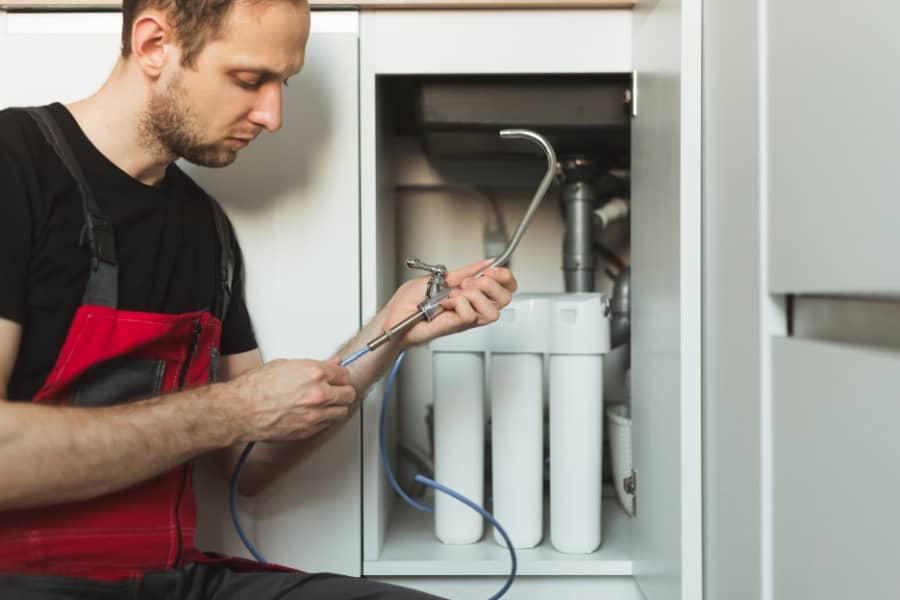
Reverse osmosis water softeners are particularly suitable for point-of-use applications. Reverse osmosis systems force water through a fine membrane that filters out minerals and other contaminants. These water systems can be expensive, so they are rarely used in whole-house systems. They are most often installed beneath a sink to soften water at a single access point.
A shower head softener is another example of a point-of-use water softener. These are often salt-based filters that treat water as the water flows through your shower head. They’re most suitable for homes where water isn’t hard enough to need a whole-house water system but is hard enough to dry out your hair and skin. In this case, installing a shower head softener is a good compromise.
Whole-House Water Softening Systems
If your water hardness level is moderate to high, then point-of-use softeners aren’t always a good solution. A high level of water hardness typically means you’re dealing with all the problems of hard water wherever you use water in the home. You need a water solution that works at multiple access points, so a whole-house water filtration system is more efficient and effective.
Whole-house water softeners work by something called ion exchange. The ion exchange process relies on the fact that calcium and magnesium ions have a positive charge. These systems use a tank that contains resin beads that have a negative charge. As the water passes through the tank, the positively charged magnesium and calcium stick to the negatively-charged beads.
This process removes the calcium and magnesium that makes the water hard. This process also uses a salt solution to soften the water and flush the tank after each treatment cycle. The treated water is very slightly salty, but it’s at a level that most people cannot taste.
Homes that use a lot of water may benefit from a dual-tank system that utilizes two ion exchange tanks. These systems are more expensive and require more installation space, but they are able to handle larger volumes of water.
Salt-Free, Template-Assisted Crystallization Water Softeners
Ion exchange softeners are salt-based systems, but there are salt-free alternatives for home water softening too. These are template-assisted crystallization systems. They use tiny polymer beads that encourage dissolved minerals to form into crystals. This removes dissolved minerals from the water so they don’t cause scaling and other hard water issues. These systems are best for homes with low to moderate hard water issues.
Magnetic Water Descalers
These work by applying a magnetic field that strips dissolved minerals of their magnetic charges. This prevents the minerals from depositing as scale onto surfaces. Technically, this means they are not water softeners but rather are descalers because minerals aren’t removed from the water.
Magnetic treatment is popular because it doesn’t require direct access to the water supply, so the installation is relatively simple. However, these systems do require electricity to generate the magnetic field.
Dealing with hard water can be time-consuming, but water-softening systems provide a much more effective and efficient solution! We can help solve your hard water problems-for good. From choosing a water softener for your home to installation and maintenance, we’ve got you covered.
FAQs
If resin beads remove hardness, why does a water softener need salt?
Resin beads capture calcium and magnesium during normal operation. Eventually, their available exchange capacity becomes depleted. Salt creates the brine used during regeneration, releasing the collected hardness minerals and restoring the resin’s ability to soften water.
Where do the hardness minerals go after regeneration?
The calcium and magnesium removed from the resin leave through the softener’s drain line with the used regeneration solution. They are discharged from the system rather than stored indefinitely inside the tank. Proper drain installation is therefore essential to setting up the equipment.
Does a water softener regenerate every time someone uses a faucet?
No. Softening and regeneration are separate operating stages. A demand-initiated system tracks water use or hardness-related capacity and regenerates when needed. A timer-controlled model follows a programmed schedule. Regeneration frequency depends on the equipment, incoming hardness, and household water consumption.
Can a water softener replace a drinking water filter?
A conventional softener primarily addresses calcium and magnesium. Don’t assume it removes germs, chlorine, or every unwanted contaminant. If you have additional water quality concerns, use testing results to select treatment certified for the specific substances you want to reduce.
Will a salt-free conditioner remove calcium and magnesium?
Many salt-free conditioners aim to limit scale formation while leaving calcium and magnesium in the water. This differs from ion-exchange softening, which removes hardness ions. Review the specific technology and independently verified performance claims before choosing between a conditioner and a softener.
How can I check whether my water softener is actually working?
Use a hardness test kit to compare untreated incoming water with water from a faucet supplied by the softener. Follow the test instructions and your equipment manual. Periodic testing gives a clearer indication of treatment performance than relying on water taste, appearance, or feel alone.
Conclusion
Understanding how a water softener works helps you choose suitable treatment for your home. By removing calcium and magnesium through ion exchange, these systems reduce hardness and limit scale buildup. Correct sizing, regular salt checks, and routine maintenance support consistent performance. Contact CW Service Pros to discuss water softening options that match your household’s needs and budget.